Your gutters are the first line of defense between your home and thousands of dollars in water damage and most homeowners never think about them until it’s too late. If you’re searching for a new gutter install service in Columbia, SC, you’re already ahead of the curve. And if you want it done right the first time, this guide will walk you through everything from choosing the right gutter system to understanding what a professional installation actually involves.
At WW Gutters, we’ve seen what happens when gutters are ignored, undersized, or installed by someone who cuts corners. It’s never pretty. Foundation cracks, rotted fascia boards, flooded basements all of it traces back to a drainage system that wasn’t up to the job
Why Columbia, SC Homeowners Can’t Afford to Skip Proper Gutter Installation
Columbia sits in the Midlands of South Carolina, where the climate is no joke. The city receives an average of 46 inches of rainfall per year well above the national average of 38 inches. Add in the occasional tropical storm remnant pushing inland from the coast, and you’re dealing with a serious volume of water that needs somewhere to go.
Without a properly installed gutter system, that water cascades off your roofline and pools directly against your home’s foundation. Over time, hydrostatic pressure builds up in the soil. Cracks appear. Moisture seeps into crawl spaces. Mold follows. What started as a $1,500 gutter installation becomes a $15,000 foundation repair or worse.
The Real Cost of Neglecting Gutter Replacement
Homeowners often delay replacing old or damaged gutters because they don’t see the immediate impact. But water damage is a slow and silent destroyer. The National Association of Home Builders estimates that water intrusion is responsible for more than 40% of all structural damage in American homes. In a humid climate like Columbia’s, that number climbs even higher.
Old galvanized gutters, sagging sectional systems held together with aging sealant, or gutters that were simply installed at the wrong pitch all of these create the same problem. Water doesn’t drain properly, overflows during heavy rain, and deposits moisture exactly where you don’t want it.
How Columbia’s Soil and Landscape Make It Worse
Much of Columbia’s residential soil has a clay-heavy composition. Clay doesn’t absorb water the way sandy or loamy soils do it holds it. When rainwater consistently drains off a roofline and saturates clay-heavy soil along a foundation perimeter, that soil expands. When it dries out, it contracts. That repeated cycle of expansion and contraction is what causes foundation settlement and cracking over years and decades.
A correctly New Gutter Installation in Columbia, SC with properly positioned downspouts directed at least six feet away from the foundation breaks that cycle before it starts.
What a Professional New Gutter Installation Actually Involves
A lot of homeowners imagine gutter installation as a one-afternoon job. Slap up some aluminum channels, attach a few brackets, done. In reality, a quality installation from a seasoned contractor involves multiple decisions, measurements, and material considerations that determine whether those gutters will perform for five years or twenty-five.
Choosing the Right Gutter Style for Your Home
The two most common gutter profiles installed on residential homes in the Columbia area are K-style gutters and half-round gutters. K-style gutters named for their profile shape, which resembles a decorative crown molding, are the industry standard for modern construction. They carry more water volume than half-round styles of the same width, and they mount flat against the fascia board, which makes them more structurally stable.
Half-round gutters have a classic, curved profile that looks beautiful on older craftsman-style homes, historic properties, and traditional colonial architecture. Many homeowners in Columbia’s older neighborhoods like Shandon, Elmwood Park, and Wales Garden prefer half-round gutters to preserve the character of their homes.
For most new gutter installation, 5-inch K-style gutters handle standard roof pitches and square footage without issue. Homes with steeper pitches, larger roof surfaces, or overhanging tree cover often benefit from 6-inch gutters, which move significantly more water volume during heavy rain events.
Seamless vs. Sectional Gutters: Why the Difference Matters
This is one of the most important decisions in any gutter installation, and it’s one where a lot of homeowners don’t realize they even have a choice.
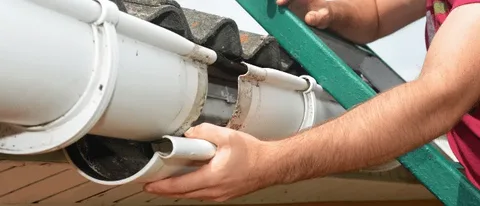
Sectional gutters come in pre-cut lengths that are joined together on-site. Every joint is a potential leak point. Even with the best sealant, those joints expand and contract with temperature changes, eventually separating and allowing water to escape. In Columbia’s hot summers and occasional winter freezes, thermal cycling accelerates the process.
Seamless gutters are fabricated on-site using a roll-forming machine. A single continuous piece of aluminum or steel, copper, or zinc runs the entire length of your roofline, with joints only at corners and downspout connections. The result is a dramatically more watertight system that holds up far better over time. According to industry data, seamless gutters account for more than 70% of all new gutter installations in the United States precisely because of their performance advantages.
WW Gutters installs seamless gutter systems as the default for new construction and full replacements, because it’s simply the smarter long-term investment for homeowners in this region.
Material Selection: Aluminum, Copper, and Steel
Aluminum is the material of choice for the vast majority of residential gutter installations in Columbia. It doesn’t rust, it’s lightweight, it comes in a wide range of colors, and it’s cost-effective. Properly installed aluminum gutters in this climate routinely last 20 years or more.
Copper gutters are a premium option that develops a beautiful patina over time. They’re exceptionally durable copper gutters that can last 50 to 100 years with minimal maintenance but the material and labor cost is substantially higher. They’re best suited for high-end custom homes, historic restorations, or homeowners who want a truly distinctive look.
Galvanized steel gutters offer additional strength for heavy-snow regions but are less common in the Southeast. Zinc is another premium option gaining traction in architectural applications, prized for its self-healing oxide layer that protects against corrosion.
For most Columbia homeowners, .027-gauge aluminum strikes the best balance between durability, performance, and value.
The Installation Process: What to Expect from Start to Finish
Understanding what a professional installation looks like helps you evaluate contractors and set realistic expectations. Here’s how a quality gutter installation unfolds.
Pre-Installation Assessment and Measurement
Before a single piece of material gets cut, an experienced installer walks the entire roofline and evaluates the existing fascia boards. If the wood is soft, rotted, or pulling away from the rafters, it needs to be repaired or replaced before new gutters go up. Attaching new gutters to compromised fascia is one of the most common installation mistakes made by inexperienced contractors; the gutters sag, pull away, and ultimately fail within a few seasons.
The installer also maps out the correct slope for drainage. Gutters should slope approximately one-quarter inch for every ten feet of run toward each downspout. Too flat and water pools and stagnates, becoming a breeding ground for mosquitoes and accelerating corrosion. Too steep and the pitch becomes visible and aesthetically jarring.
Downspout placement is planned at this stage, too. The number and location of downspouts determines how efficiently the system drains during peak rain events. A general rule of thumb used by professional installers is one downspout for every 30 to 40 linear feet of gutter, though roof pitch, surface area, and local rainfall intensity all factor into that calculation.
The Day of Installation
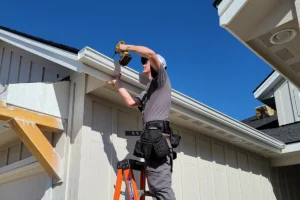
On installation day, the crew arrives with the roll-forming equipment needed to fabricate seamless gutters on-site to the exact measurements taken during the assessment. Gutters are cut to length, end caps are sealed, and drop outlets are positioned at downspout locations.
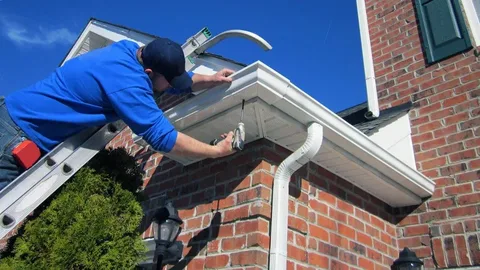
Hangers are installed at intervals no greater than 24 to 30 inches closer spacing in areas with heavy leaf accumulation or where the gutter system needs to support gutter guard systems. Hangers that are spaced too far apart allow gutters to flex and bow under the weight of standing water, pulling the system away from the fascia over time.
Downspouts are secured to the exterior wall with brackets and directed away from the foundation, ideally into splash blocks or underground drainage lines that carry water to a safe discharge point away from the structure.
Gutter Guards and Leaf Protection Systems
Columbia’s tree canopy is one of the city’s great charms and one of its homeowners’ biggest maintenance headaches. Pine needles, oak leaves, sweet gum balls, and debris from pecan trees fill gutters rapidly during fall and after storms.
Gutter guard systems also called leaf protection or gutter covers sit over the top of the gutter channel and allow water to flow in while blocking debris. Technology has advanced considerably in the past decade. Micro-mesh gutter guards, which use a fine stainless steel mesh bonded to an aluminum frame, are widely regarded by industry professionals as the most effective option for blocking fine debris like pine needles while maintaining strong water flow.
A quality gutter guard system doesn’t eliminate maintenance entirely, but it dramatically reduces cleaning frequency from twice a year to once every few years in most cases. For homeowners with mature trees, the long-term labor savings and reduced clog-related damage make it a worthwhile addition to any new installation.
How to Choose the Right Gutter Installation Company in Columbia, SC
The gutter industry, like many home services trades, has a low barrier to entry. A truck, a ladder, and some tools are enough for someone to call themselves a gutter contractor. That means homeowners need to be deliberate about who they hire.
What to Look for in a Local Gutter Contractor
Licensing and insurance are non-negotiable starting points. In South Carolina, contractors should carry general liability insurance and workers’ compensation coverage. If a worker is injured on your property and the contractor isn’t properly insured, you could be held liable. Always ask for proof of insurance before signing anything.
Experience with seamless gutter fabrication matters more than general handyman experience. Rolling seamless gutters on-site requires specific equipment and technique. Ask any contractor you’re considering how long they’ve been installing seamless systems specifically, not just how long they’ve been in business.
References and online reviews give you a window into real customer experiences. Look for contractors with a consistent pattern of positive reviews that mention specific details — installation quality, cleanup, professionalism, how the system performed after heavy rain. Generic five-star reviews without detail are less meaningful than specific accounts of the work.
Questions Worth Asking Before You Sign a Contract
Ask about the gauge of aluminum they use. A reputable contractor installs .027-gauge aluminum as standard; some budget installers use thinner .025-gauge material that dents more easily and has a shorter service life. Ask about hanger spacing, how they handle fascia repairs if needed, and what their warranty covers both on materials and labor.
A quality gutter installation from a professional contractor typically carries a workmanship warranty of at least one to two years, with manufacturer warranties on materials running ten years or longer. Any contractor who hesitates to discuss warranties is a contractor worth skipping.
Maintaining Your New Gutter System for Long-Term Performance
Installation is the beginning, not the end. Even the best gutter system needs periodic attention to continue performing at its best.
Cleaning gutters at least twice a year once in late spring and once in late fall after leaf drop keeps debris from building up and impeding water flow. In Columbia’s environment, with significant tree coverage in many neighborhoods, more frequent cleaning may be necessary.
After major storms, a quick visual inspection from the ground can reveal obvious issues: gutters pulling away from the fascia, sections that have shifted, or downspouts that have been knocked loose. Catching small problems early prevents them from becoming expensive ones.
Checking downspout discharge points periodically ensures that water is actually moving away from the foundation as designed. Splash blocks shift over time. Underground drainage lines can clog with root infiltration. These are easy things to address when caught early and complicated, costly problems when ignored for years.
The Bottom Line
Getting a new gutter system installed on your Columbia home isn’t just routine maintenance, it’s one of the most effective things you can do to protect your property’s structural integrity for the next two decades. The right contractor, the right materials, and a proper installation make all the difference between a gutter system that quietly does its job for 20-plus years and one that causes problems from the first heavy rain.
WW Gutters brings the experience, materials, and local knowledge to get it right. If your current gutters are failing, aged, or simply inadequate for Columbia’s rainfall demands, now is the right time to make a change.
Frequently Asked Questions
How long does a gutter installation take?
For most single-family homes, a professional crew completes a full gutter installation in one day. Larger homes, complex rooflines, or installations that include fascia repair work may take two days.
Are seamless gutters really worth the extra cost over sectional gutters?
Yes, in virtually every case. The reduced leak risk, longer service life, and cleaner appearance make seamless gutters the better long-term value, even if the upfront cost is slightly higher than sectional systems.
What size gutters does my Columbia home need?
Most homes in Columbia do well with 5-inch K-style gutters. Homes with larger roof surfaces, steeper pitches, or significant tree coverage often benefit from 6-inch gutters, which handle higher water volume during heavy rain events.
How often should gutters be replaced?
Properly maintained aluminum gutters typically last 20 years or more. Signs that replacement is overdue include persistent leaking at joints, widespread sagging, visible rust or corrosion, and gutters that pull away from the fascia repeatedly despite being re-secured.
Can I install gutters myself to save money?
While DIY gutter installation is possible, it carries real risks — incorrect slope, improper hanger spacing, and inadequate downspout placement are common mistakes that lead to drainage failure and property damage. For a home as significant an investment as yours, professional installation is almost always the smarter financial decision.